
| Provider | Price ($) | Speed - Download (Mbps) | $/Mbps Down | Speed - Upload (Mbps) | Location | Package Name | Terminal Fee ($) |
|---|---|---|---|---|---|---|---|
| Starlink | $50 | 100 | $0.50 | 10 | Nationwide | Starlink- Personal | $389 |
| iBoom | $75 | 100 | $0.75 | Yap | Home Broadband Internet Promo | ||
| iBoom | $99 | 100 | $0.99 | Yap | Home Fast Interest+ Mobile SIM | ||
| MCS Pohnpei | $78 | 50 | $1.56 | 10 | Kosrae, Pohnpei, Chuuk | Gbyte Plan- 30GB | $627 |
| MCS Pohnpei | $125 | 50 | $2.50 | 10 | Kosrae, Pohnpei, Chuuk | Gbyte Plan- 50GB | $627 |
| MCS Pohnpei | $230 | 50 | $4.60 | 10 | Kosrae, Pohnpei, Chuuk | Gbyte Plan- 100GB | $627 |
| FSMTC | $49 | 10 | $4.90 | 3 | Pohnpei, Chuuk, Yap | Kaboom Bronze | |
| FSMTC | $99 | 20 | $4.95 | 5 | Pohnpei, Chuuk, Yap | Kaboom Gold |
The FSM telecommunications market offers a range of services to consumers, including:
- Fixed voice telephony: This is like a traditional home phone. It uses wires (like copper or fiber) to connect your home or business to the phone network.
- Mobile (internet and voice): This uses radio waves to connect your device (like a smartphone or tablet) to the internet and allows you to make and receive phone calls.
- Fixed internet: This uses wires (like copper or fiber) or satellite technology to connect your home or business to the internet.
To provide these services, companies often need to buy access to a network from other companies. This is called a “wholesale” service. FSM Telecommunications Cable Corporation, also known as CableCorp or OAE, is the government-owned wholesale service provider in the FSM. CableCorp cannot provide services to customers; they connect the FSM to the rest of the world through subsea fiber cables. CableCorp is also building an open-access fiber optic network to reach most households and businesses on all of the FSM’s main islands.
The timeline below shows how the industry has changed since reform started in 2014.
Figure 1.1: Timeline of competition in the FSM
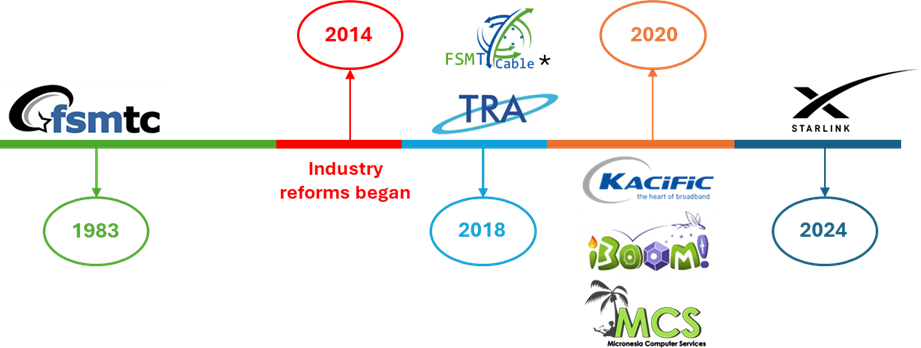
*FSMTCable is also known as OAE/CableCorp
This timeline includes active operators only. Other operators have been licensed but have not started providing services yet.
The map below shows which retailers operate in which parts of the FSM
Figure 1.2: Retail operators in the FSM
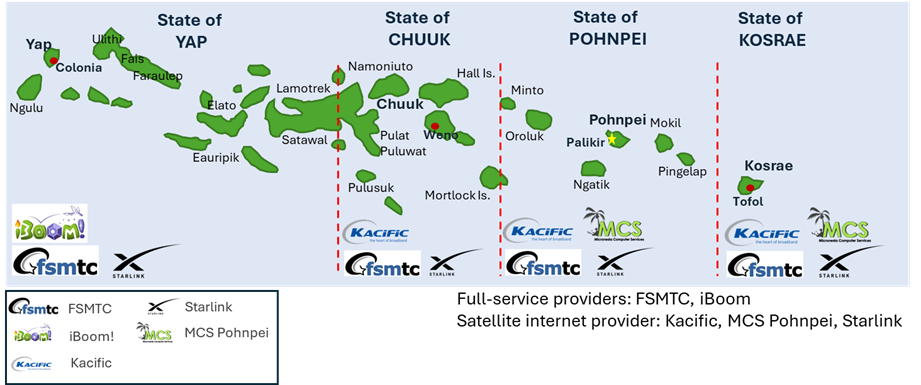
Since 2018, the internet market in the FSM has been growing slowly but steadily. New service providers like Kacific, Starlink, and iBoom! have brought more competition and new choices for consumers. With faster speeds and more reliable connections, consumers are benefiting from this increased competition. The TRA expects even more competition as FSM Telecommunications Cable Corporation completes its fiber rollout across all four states.
When selecting internet services, it is important to consider:
- Location: What is available in your area
- Cost: Everyone has a budget, and not everyone needs a premium plan. Some services, such as satellite, might also have upfront costs to purchase connectivity hardware
- Speed/ Type of service: Higher maximum speeds allow for faster downloads, online gaming, and website loading. What does the internet need to do for you?
This page outlines each consideration and compares the FSM’s industry statistics to those of similar Pacific Islands.
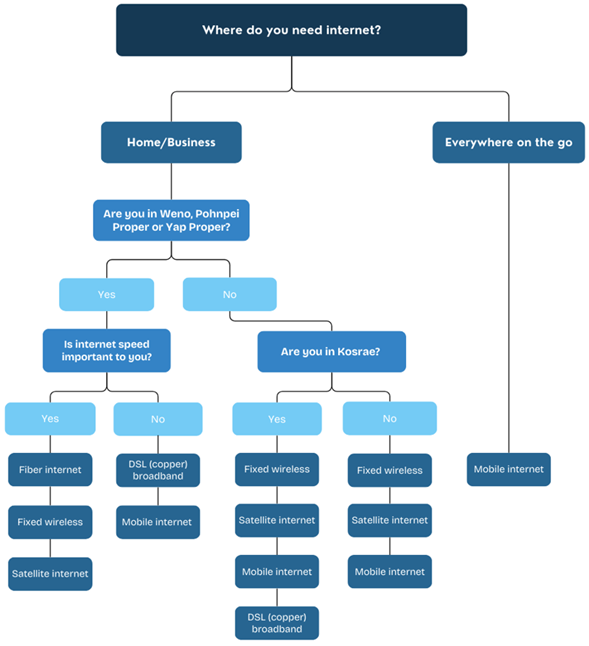
The following diagram may help you to understand why type of service is best for your needs.
Figure 2.1: What internet services best suit your needs
Type of service
Table 2.1: Type of service
| Type of Internet | Description |
|---|---|
| Fiber-optic broadband | Fiber internet offers faster connection speeds, lower latency, and more reliable services compared to older copper-based networks. |
| DSL (Copper) broadband | DSL broadband is an older technology that uses copper wires to deliver the internet. DSL may be an alternative to Fiber-optic if speed is less important to you. |
| Satellite | Satellite internet can be a high-speed alternative to fiber-optic broadband and is available anywhere covered by the provider's satellites. It requires the purchase and installation of a satellite terminal. |
| Fixed wireless | Fixed wireless internet uses mobile internet technology to provide a fixed connection for your home or office. Fixed wireless is an option for customers wanting a fixed connection in locations where Fiber-optic or DSL internet isn't available. |
| Mobile | Mobile internet is provided via a SIM card to a mobile device. The service quality depends on the technology offered by your service provider and your connection to a nearby cell tower. It can be expensive for large data plans. |
Services available in your location
Your location will determine the services available to you. Not all service providers operate in all locations.
Click on the name of your island group in the table below to find out what service providers operate in your area.
Price
The TRA has compiled information about available internet plans in the FSM to inform you about what you could purchase.
Use the linked table below to compare current internet plans offered in the FSM.
- Home plans<link>
- Business plans<link>
Disclaimer: Prices and plan details were extracted from the providers’ websites in October 2024. Please refer directly to the providers’ websites for the most up-to-date information.
Internet market statistics
The TRA collects and monitors statistics about the FSM fixed internet market and how it compares to similar countries.
Pacific price comparisons
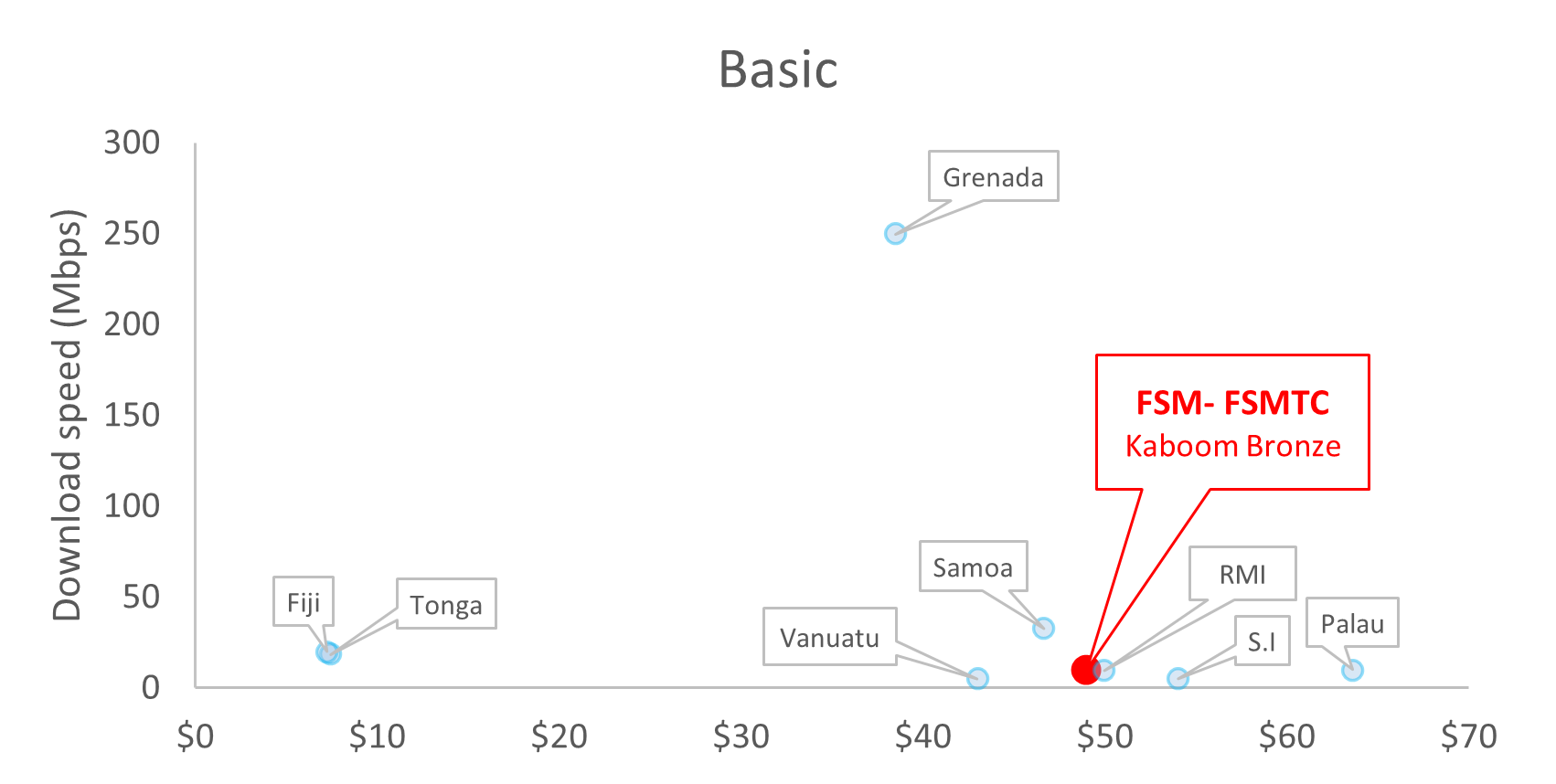
To compare plans, we define a ‘basic’ and ‘premium’ service and compare the cheapest plan that meets the standards in each country.
- A basic service must have an advertised speed of at least 1.5Mbps
- A premium service must have an advertised speed of at least 4Mbps and a monthly data limit of at least 50Gb
Note that for some countries, the cheapest plan meets both the basic and premium service requirements.
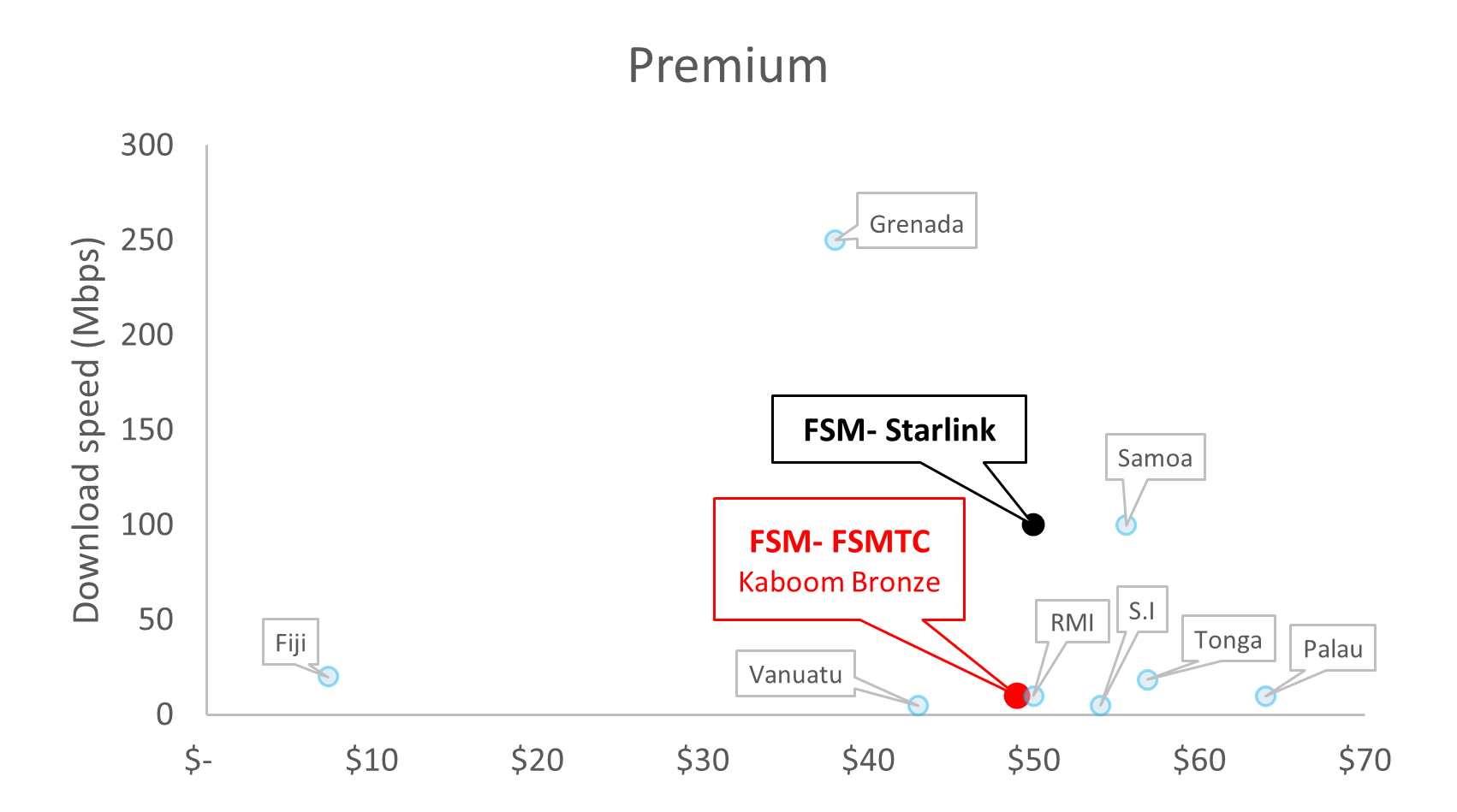
The graphics below compare selected Pacific countries’ basic and premium service plans against their download speeds.
Figure 2.2: Comparison of the FSM’s basic and premium fixed internet prices vs. comparator countries
This table further compares the FSM’s fixed internet market in the Pacific.
Table 2.3: Comparison of the fixed internet market in the Pacific
| Country | Service | Price (USD) | Percentage of Average Income | Download Speed | Data Limit |
|---|---|---|---|---|---|
| The FSM | Basic & Premium | $49 | 14.2% | 10 Mbps | Unlimited |
| Fiji | Basic & Premium | $7.25 | 1.6% | 20 Mbps | 75 GB |
| Tonga | Basic | $7.42 | 1.8% | - | 5 GB |
| Tonga | Premium | $56.87 | 13.8% | - | 5 GB |
| Vanuatu | Basic & Premium | $43 | 14.1% | 5 Mbps | Unlimited |
| Samoa | Basic | $46.63 | 15.3% | - | 50 GB |
| Samoa | Premium | $55.57 | 18.2% | 100 Mbps | 45 GB |
| Solomon Islands (S.I) | Basic & Premium | $54 | 29.3% | 4-6 Mbps | Unlimited |
| Kiribati | Basic | $21 | 9.0% | - | 9 GB |
| Kiribati | Premium | $175 | 74.7% | - | 50 GB |
| Grenada | Basic & Premium | $38.48 | 5.1% | 250 Mbps | - |
| Palau | Basic & Premium | $63.6 | 27.2% | 10 Mbps | Unlimited |
| The Republic of the Marshall Islands (RMI) | Basic & Premium | $49.95 | 8.8% | 10 Mbps | Unlimited |
Pacific fixed internet penetration
Efforts are being made to expand the use of fixed internet throughout the FSM and other Pacific Island countries.
As in many Pacific Island countries, fixed internet penetration in the FSM is low (well below 10 percent of the population). However, comparing Grenada shows that significant improvement is possible following a nation-wide fiber-to-the-premise (FTTP) rollout, and this is what the CableCorp FTTP rollout aims to achieve.
Figure 2.3: Percentage of residents with fixed internet

Internet access in outer islands
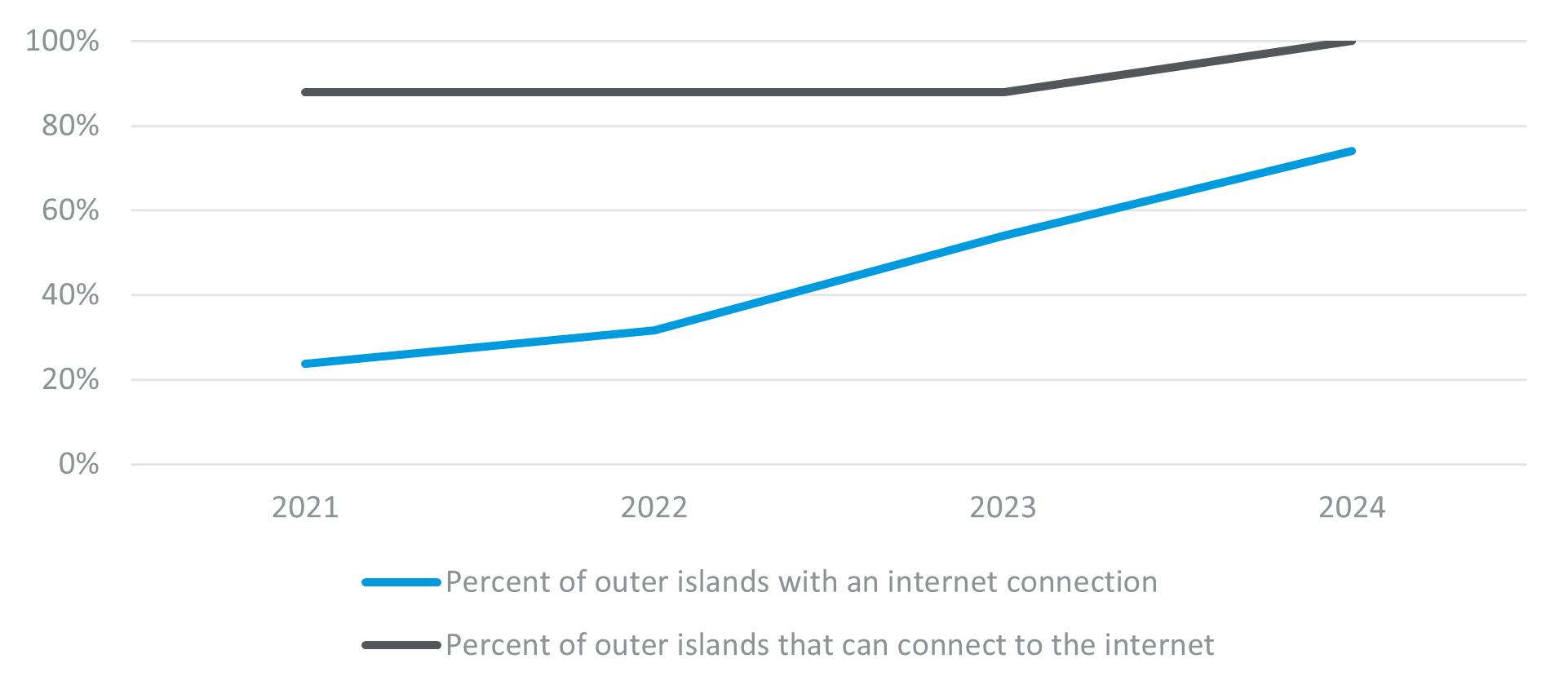
The recent arrival of low-earth-orbit satellite constellations, such as Starlink, has increased outer island coverage from 88 percent to 100 percent. This means that consumers can access the internet from anywhere in the FSM, as long as they have a satellite connection and a power source.
Figure 2.4: Internet availability in the FSM outer islands
Traditional mobile services include text messaging (SMS) and calls. With mobile, calls can be made to other mobile phones and landline (fixed telephony) phones. The services are described below:
- SMS—Mobile services allow for text (and sometimes picture and video) messages to be sent between mobile phones. Depending on your service provider and mobile plan, SMS may be charged per message, or you may be allowed to send a certain amount of messages each month or week for a fixed price
- Calls—Mobile services allow for calls to be made between mobile phones and landline phones. Calls are often charged per minute or as a set amount per week or month
- Internet (Data)—Mobile services allow users to access the internet from their mobile devices. Internet services are often charged per megabyte or as per a set amount of megabytes per day, week, or month. Mobile Internet is discussed further in Table 2.1.
Choosing the right mobile service option in the FSM can depend on:
- Type of service: What services are available in your location, and at what price
- Changing technology
What services are available
The table below shows the licensed mobile service providers and their operating locations and pricing in the FSM.
The lack of competition in the mobile market could be a major contributing factor to the lack of progress. FSMTC is the only provider of nation-wide mobile services in the FSM. All other comparator countries, except RMI and Palau, have at least two major mobile service providers.
Table 3.1: Mobile service providers in the FSM
| Service Providers | Locations Available | Services and Pricing Link |
|---|---|---|

|
All main state islands. Outer islands: Pakin, Poluwat, Oneop, Onoun, Ahnd, Moch, Satowan, Pulap, Parem |
FSMTC Plans |

|
Yap |
Mobile Plan Home Internet |
Changing technology
Changes in technology mean that some mobile services are increasingly being provided through over-the-top (OTT) services using mobile data (internet). OTT services are generally free to use. Users can make unlimited calls and send unlimited messages to other users worldwide at no additional charge.
OTT applications (like Facebook Messenger and WhatsApp) are great for chatting and calling with friends and family who also have these apps on their phones or devices. But they can’t be used to call people on landline phones. So, if you need to call someone who only has a landline, you’ll still need to use your mobile phone’s regular calling feature.
Mobile market statistics
The TRA collects and monitors statistics about the FSM mobile market and how it compares to similar countries. This section will compare the FSM’s service prices, mobile usage, and access to outer islands.
Mobile service providers
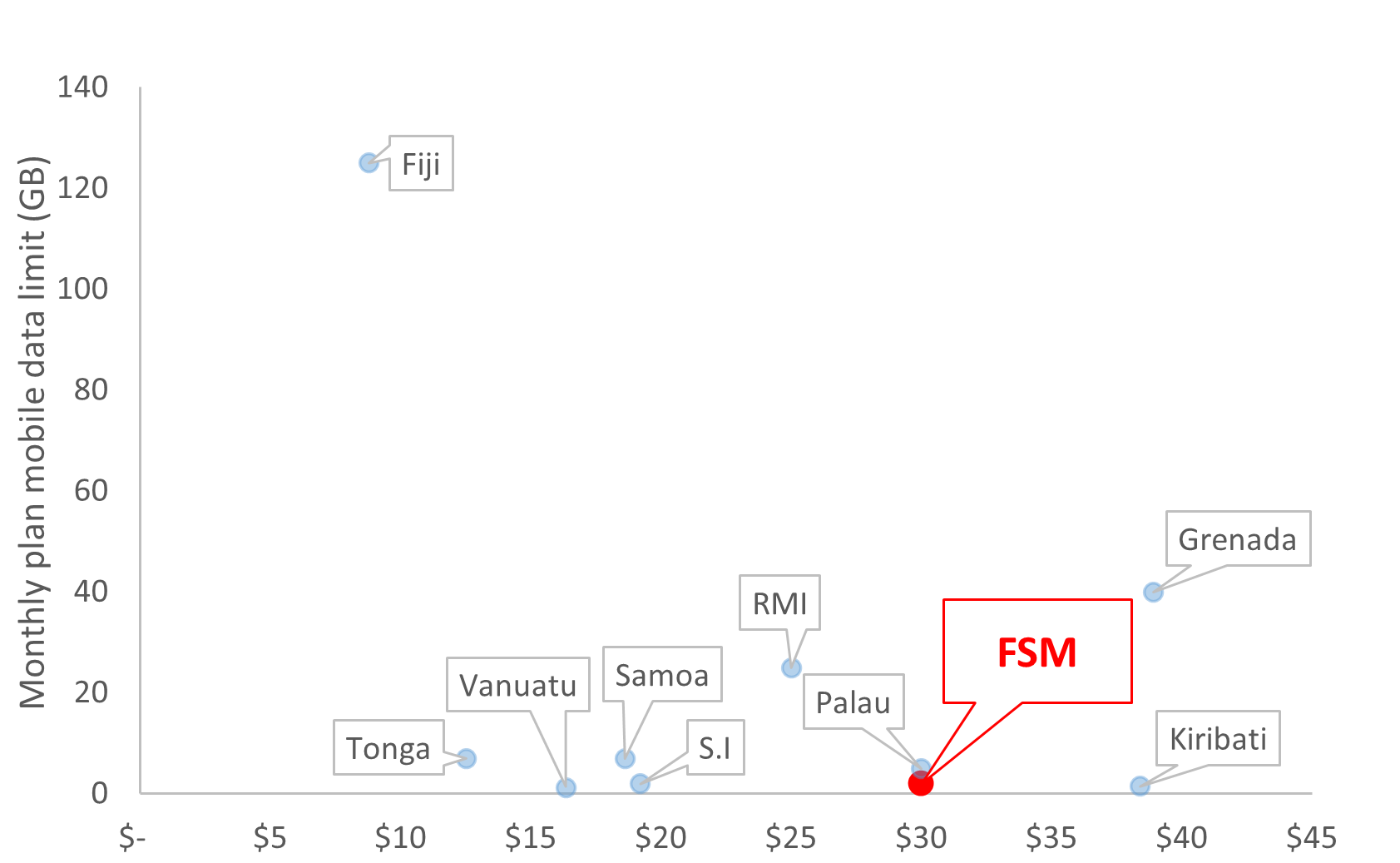
The TRA monitors the price of ‘basic’ mobile plans across a range of countries. A ‘basic’ monthly plan includes a minimum of 1GB of data, 60 minutes of call time, and 250 SMS.
At US$30 per month, a basic bundle in the FSM is expensive compared to most other countries we look at. Only Kiribati and Grenada have more expensive basic plans. However, Grenada’s basic plan includes significantly more (20 times more) data than what is offered for the cheapest basic FSM plan.
Figure 3.1: International mobile service provider comparison
Plans and prices were recorded from providers’ websites in October 2024. Please check the providers’ websites for the most up-to-date information.
Outer Island mobile access
Access to mobile services in outer islands is important for improving communication connectivity in the FSM. The chart below shows which outer islands currently have mobile access and approximately when they gained access.
Figure 3.2: Timeline of mobile access for the FSM outer islands
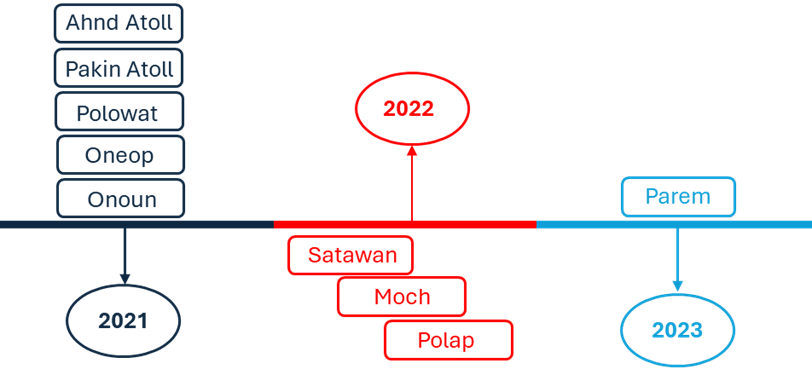
Note dates are approximate
Mobile use
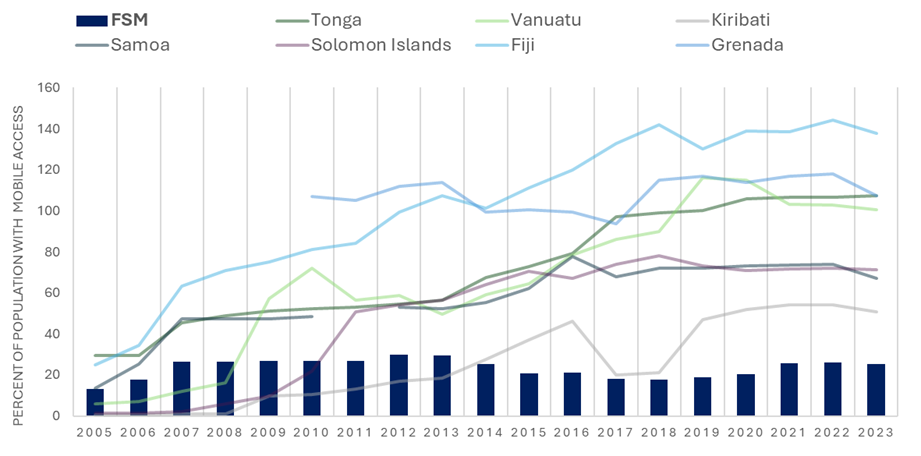
The TRA monitors mobile penetration (use of mobile services) in the Pacific. We note two significant observations:
- The FSM’s mobile use is low—At just 25 percent of the population, the FSM has the lowest mobile use out of the countries we monitor
- The FSM’s mobile use is not growing—In 2005, the FSM had among the highest mobile use out of the compared countries. However, since then, all other countries have had significant growth in mobile use, except for the FSM, which has stayed in the 20-30 percent range.
Figure 3.3: International comparison of mobile use
FSMTC is the only provider of fixed telephony services in the FSM. Its services and pricing can be found here.
Fixed telephony services are becoming obsolete as more communication happens over the internet through mobile phones and other online devices.
This trend is evident in the FSM, with FSMTC repeatedly reporting decreases in the number of Plain Old Telephone Services (POTS) subscribers in its annual reports.
Figure 4.1: Number of Plain Old Telephone Service Subscribers
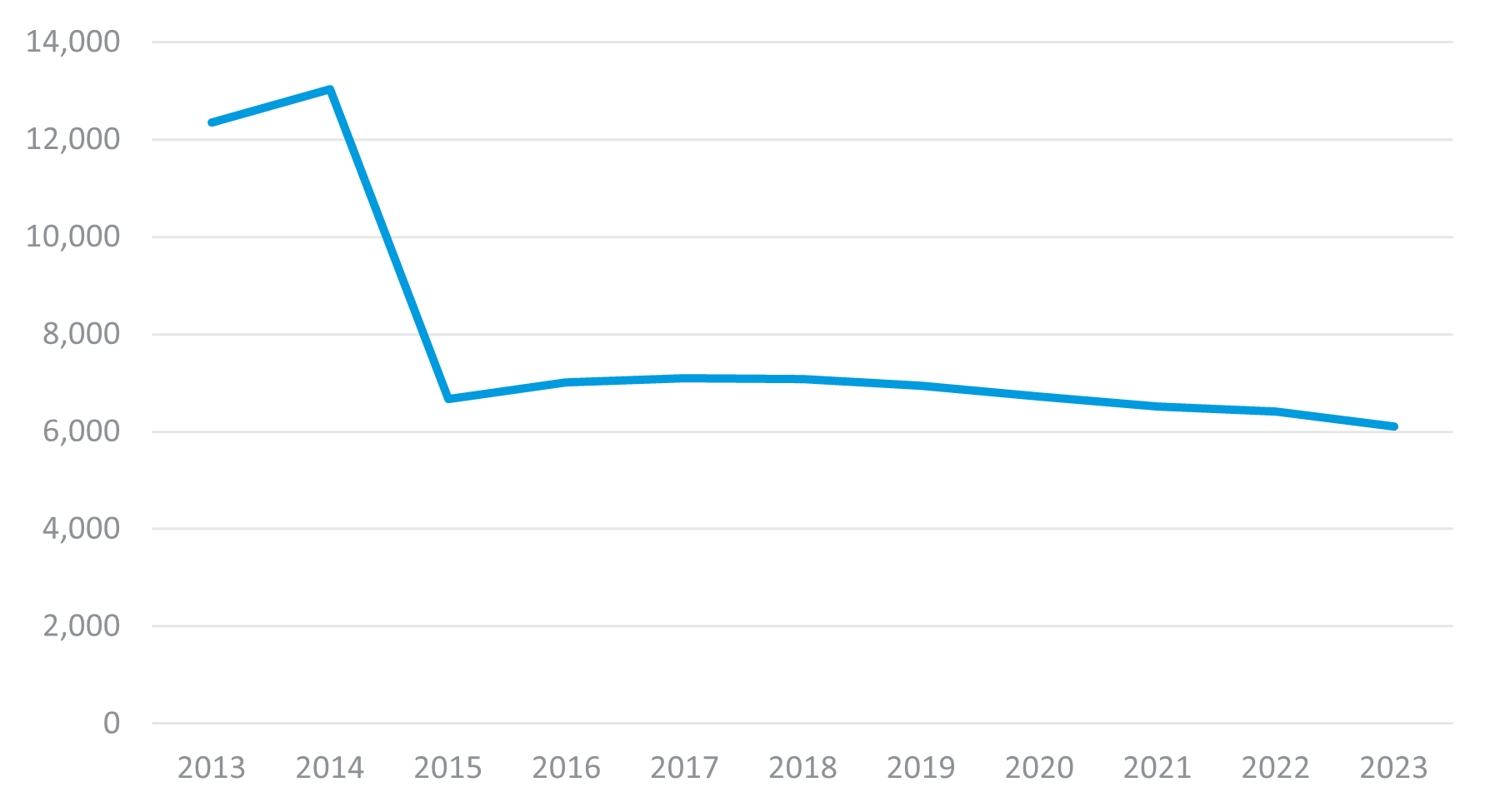
Source: FSMTC Annual Reports
We do not expect future competition in the market due to the declining subscription numbers and outdated technology.